
.svg) Product
Product

.png)


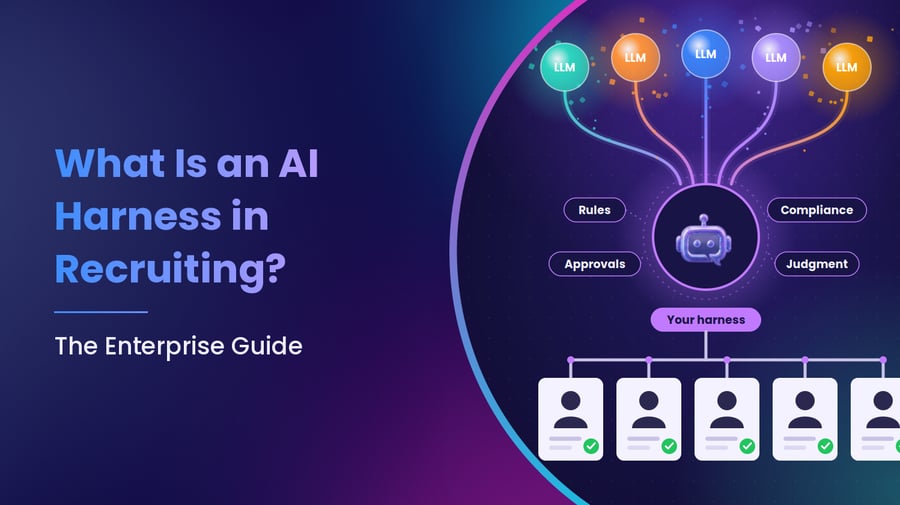


Table of content
Enterprise hiring has a new vocabulary problem. In a single quarter, TA leaders have been pitched AI copilots, AI recruiters, agentic ATS platforms and autonomous hiring. Most of these pitches lead with the model: which LLM, how many parameters, how fast it writes a job description, how it goes about assessment and so on.
That is the wrong place to start. Models are getting more capable every few months, and they are also getting replaced, repriced and retrained just as often. What decides whether AI actually works in your hiring operation is not the model. It is the AI harness: the layer that tells AI agents how your organization hires, what they are allowed to do and when a human must step in.
In short:
- AI agents = models + harness. The model is the engine. The harness is the chassis: your rules, data, processes and memory.
- An ATS records hiring. A harness orchestrates it, with agents acting inside your policies and a full audit trail.
- Agents handle coordination at volume. Recruiters keep judgment, relationships and the close.
- A harness lets you set different levels of AI autonomy by region, business unit and job family, which is how you stay compliant as AI hiring laws diverge.
- Because the harness is model-agnostic, you can switch models as prices and capabilities change without rebuilding your workflows.
What is an AI harness in recruiting?
An AI harness in recruiting is the orchestration layer that surrounds AI models and turns them into reliable hiring agents. It holds your hiring process, compliance rules, approval chains, data and institutional memory, and it controls what each agent can see, decide and do.
The clearest way to think about it is a car:
- The model is the engine. Large language models from OpenAI, Anthropic, Google and others provide raw capability: reading resumes, writing messages, summarising interviews, reasoning over data.
- The harness is the chassis. It decides where the engine's power goes. It includes the software, rules, memory and processes that keep the car on the road.
- The agent is the car you actually drive. An AI recruiting agent is what you get when a model runs inside a harness built for hiring.
Every model ships with a default harness built on general internet knowledge. That is why a general chatbot can draft a decent job description. But it does not know your salary bands, your interview panels, your background verification partner, your consent rules in Germany or your hiring manager's preferences. That knowledge is private. It lives in your systems, your recruiters' heads and your past hiring decisions.
Why the harness, not the model, is the real asset
Models commoditize. The capability gap between leading models narrows with every release, and switching from one to another is increasingly a configuration change. What does not commoditize is your organizational context: years of hiring data, the judgment of your best recruiters and the policies your legal team has signed off.
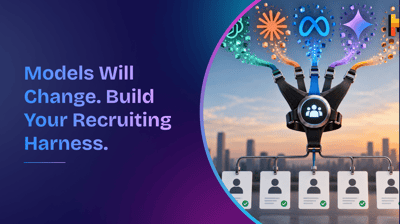
That is the idea behind a simple line worth anchoring to: models will be interchangeable; the harness is what you are actually building. An enterprise that builds its recruiting harness first gains an advantage a competitor cannot close by switching to a better model.
The institutional memory problem
Most hiring knowledge is never captured. Interviews are like Snapchat: the context disappears the moment the call ends. Why a candidate was rejected at L1, which panelist consistently over-scores, which job portal produces joiners rather than applicants in a given city. When a senior recruiter leaves, that judgment leaves with them.
A recruiting harness captures this context systematically as part of the work, so every agent and every new recruiter starts with what the organization already knows. Over time, the harness becomes your institutional memory for recruiting.
AI harness vs ATS vs point AI tools
An ATS is a system of record. A point AI tool is a feature. An AI harness is a system of action. Most enterprises today run a mix of the first two, which is why AI adoption in hiring often stalls at pilots.
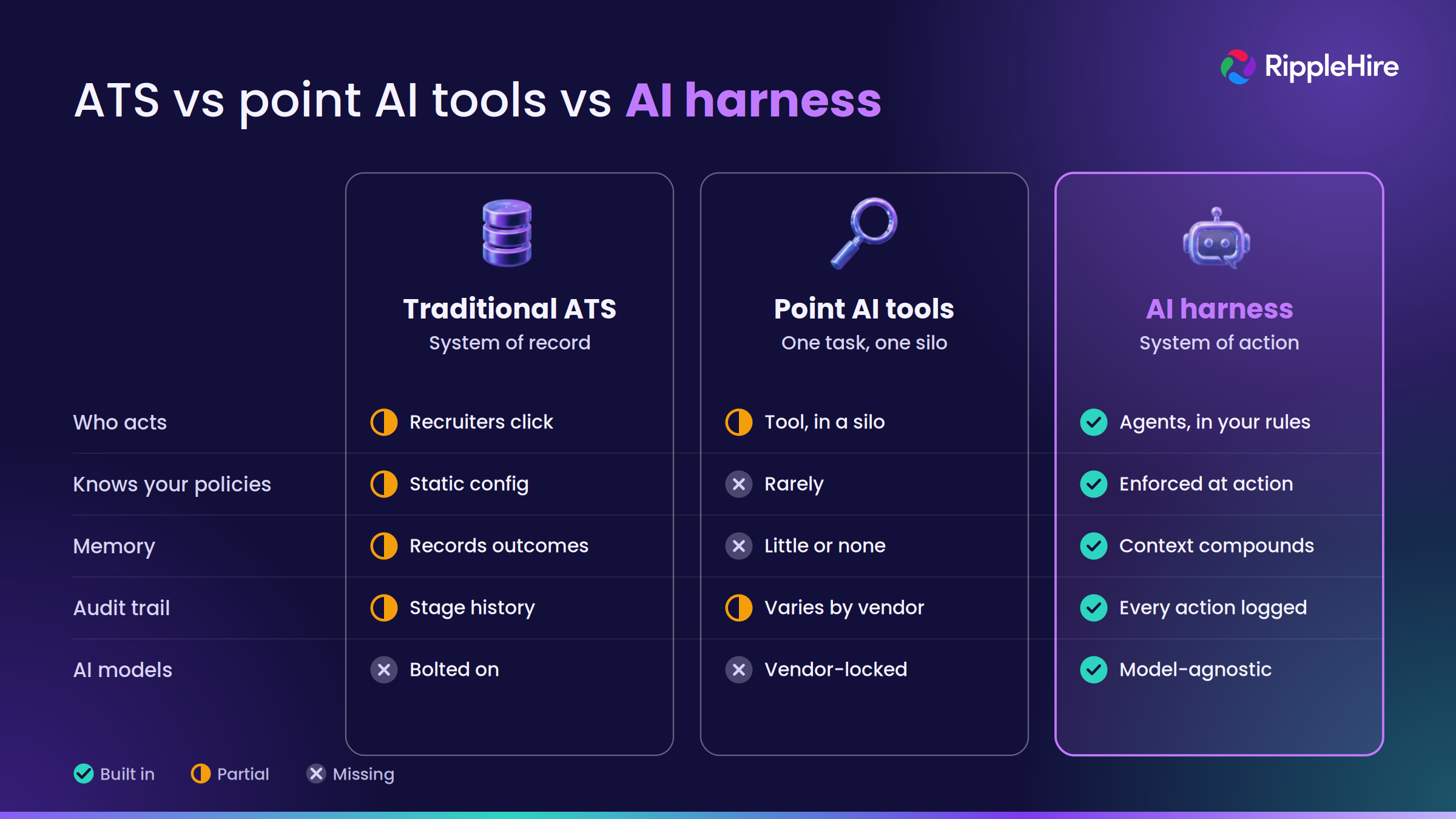
The distinction matters because the problems TA teams face in 2026 are orchestration problems, not feature gaps. Application volumes are up three to five times as candidates use LLMs to apply at scale. Around one in four profiles now gets flagged for fake credentials, proxy interviews or deepfakes. TA headcount is flat while requisitions grow. And regulators now expect AI-influenced hiring decisions to be explainable and auditable.
No single AI feature solves all four. A harness does, because it coordinates the work across every stage and keeps a record of why each decision was made. For more on how the ATS category is changing, see The Future of ATS in 2026.
The six building blocks of a recruiting harness
A recruiting harness is built from six layers: process, policy, data, memory, orchestration and governance. Leave one out and agents either cannot act or cannot be trusted.
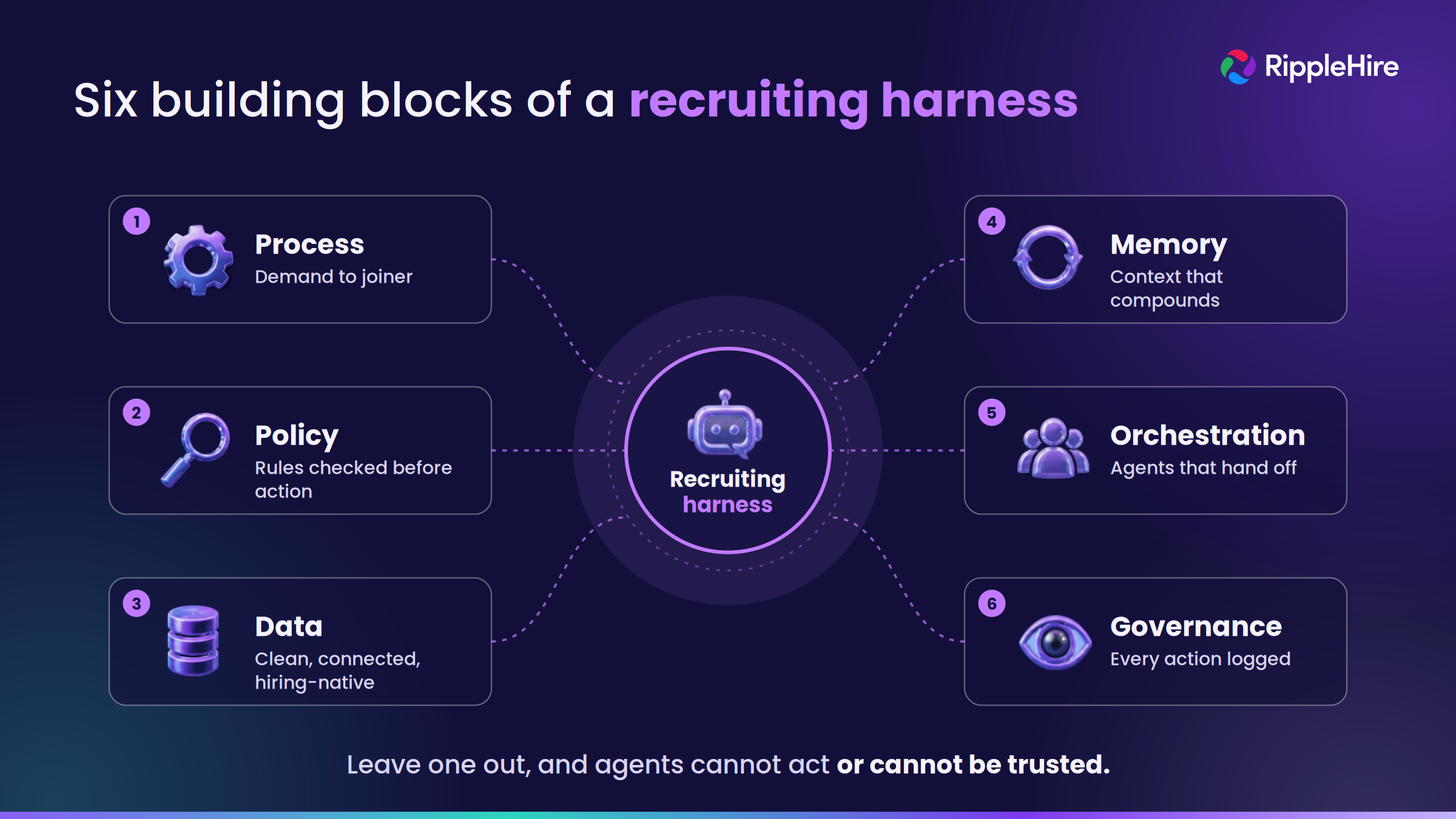
1. Process: the demand-to-joiner backbone
The harness must understand hiring end to end: requisition, sourcing, screening, interviews, offer, pre-boarding and joining. Agents need to know what stage a candidate is in, what comes next and what "done" looks like. Without this, AI stays stuck in single tasks.
2. Policy: your rules, enforced
Salary bands, approval hierarchies, diversity guidelines, notice-period rules, document requirements and consent obligations. In a harness, these are not PDFs in a shared drive. They are rules that agents check before every action, so a salary-band breach or a skipped approval is prevented rather than discovered in an audit.
3. Data: clean, connected and hiring-native
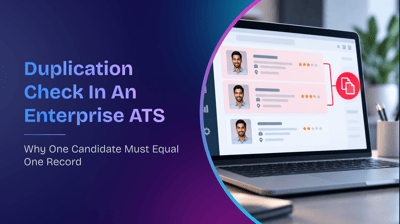
Agents are only as good as what they can see. That means one record per candidate (see why duplication checks matter), integrations with job portals, HRIS, background verification and assessment partners, and data partnerships that widen sourcing. RippleHire grounds its agents in hiring-native data drawn from 86 million candidates processed and 12 million interviews captured across 50+ countries.
4. Memory: context that compounds
Interview notes, rejection reasons, panel feedback, recruiter overrides and outcomes. A harness stores these as structured context so agents learn which channels convert, which questions predict performance and which offers are at risk of dropping out.
5. Orchestration: agents that compose
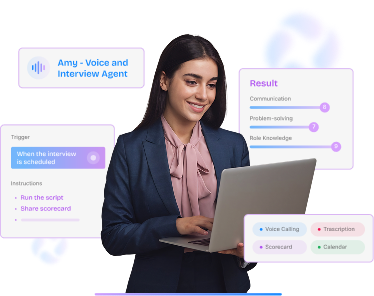
The harness decides which agent runs when, and how agents hand off to each other and to humans. In RippleHire, for example, three agents can run a fully automated voice interview flow: one triggers the call, one conducts a screening round, and one reads the call report and decides the next step.
6. Governance: trust by design
Role-based access, admin-only configuration, deterministic execution and full execution logs. Every trigger, condition and action is recorded against the job and the candidate. This is what lets your CIO, CISO and DPO approve AI in hiring rather than block it. For a deeper checklist, read the Enterprise ATS Governance Guide.
How AI recruiting agents work inside the harness
Inside a harness, every AI recruiting agent follows the same pattern: Trigger → Condition → Action. This keeps agents predictable, testable and easy for business teams to configure without code.
- Trigger: the event that starts the agent. "Candidate shortlisted," "offer accepted," "all positions filled" or a scheduled time. Triggers can be instant or batch.
- Condition: the rules that decide whether the agent should act. Role, skills, location, experience, source, notice period or any field in your system, combined with AND/OR logic.
- Action: what the agent does. Move a candidate to the next stage, unpublish a job, route an approval, trigger an AI voice interview, or send an email or WhatsApp message.
Before going live, a good harness lets you dry-run the agent against real data without executing anything, so you see exactly what it would have done. With RippleHire's Agent Builder, most no-code recruiting agents go live in under 30 minutes, with no IT ticket.
AI agents across the hiring lifecycle
| Stage | Example agent | What it does |
|---|---|---|
| Demand | Job quality agent | Checks a new requisition for missing skills, unclear criteria or biased language before it is published |
| Sourcing | Pipeline match agent | Surfaces best-fit profiles from internal talent pools, referrals and past applicants |
| Screening | Voice screening agent | Runs AI voice interviews at volume and scores responses against role criteria |
| Screening | Fraud check agent | Flags duplicate identities, proxy interview signals and inconsistent credentials |
| Interview | Interview intelligence agent | Records, transcribes and generates role-specific questions; pre-fills feedback |
| Offer | Offer compliance agent | Validates documents, keeps offers within salary bands and routes approvals |
| Pre-boarding | Joining risk agent | Tracks engagement between offer and day one and flags drop-off risk early |
| Hygiene | Ghost job agent | Unpublishes jobs automatically when all positions are filled |
The value is not in any single agent. It is in how they compose. A screening agent hands strong candidates to an interview agent, which hands a completed evaluation to a recruiter, who makes the call. Each handoff is logged, and each agent works from the same policies and context.
Bring your own agents
An open harness is not limited to the vendor's own agents. You can build agents inside the platform or plug in third-party agents and specialised products, such as a tech-first background verification partner that runs checks inside the hiring flow. That keeps you from buying another disconnected point tool every time a new need appears.
Agents + humans: human in the loop recruiting, by design
A harness does not replace recruiters. It changes what they spend their time on: agents coordinate, recruiters close. Agents take on the systematic, high-volume work. Recruiters keep judgment, relationships and the final decision.
Three levels of AI autonomy
The harness lets leadership choose how much autonomy each workflow gets. All three modes can run side by side in the same organization.
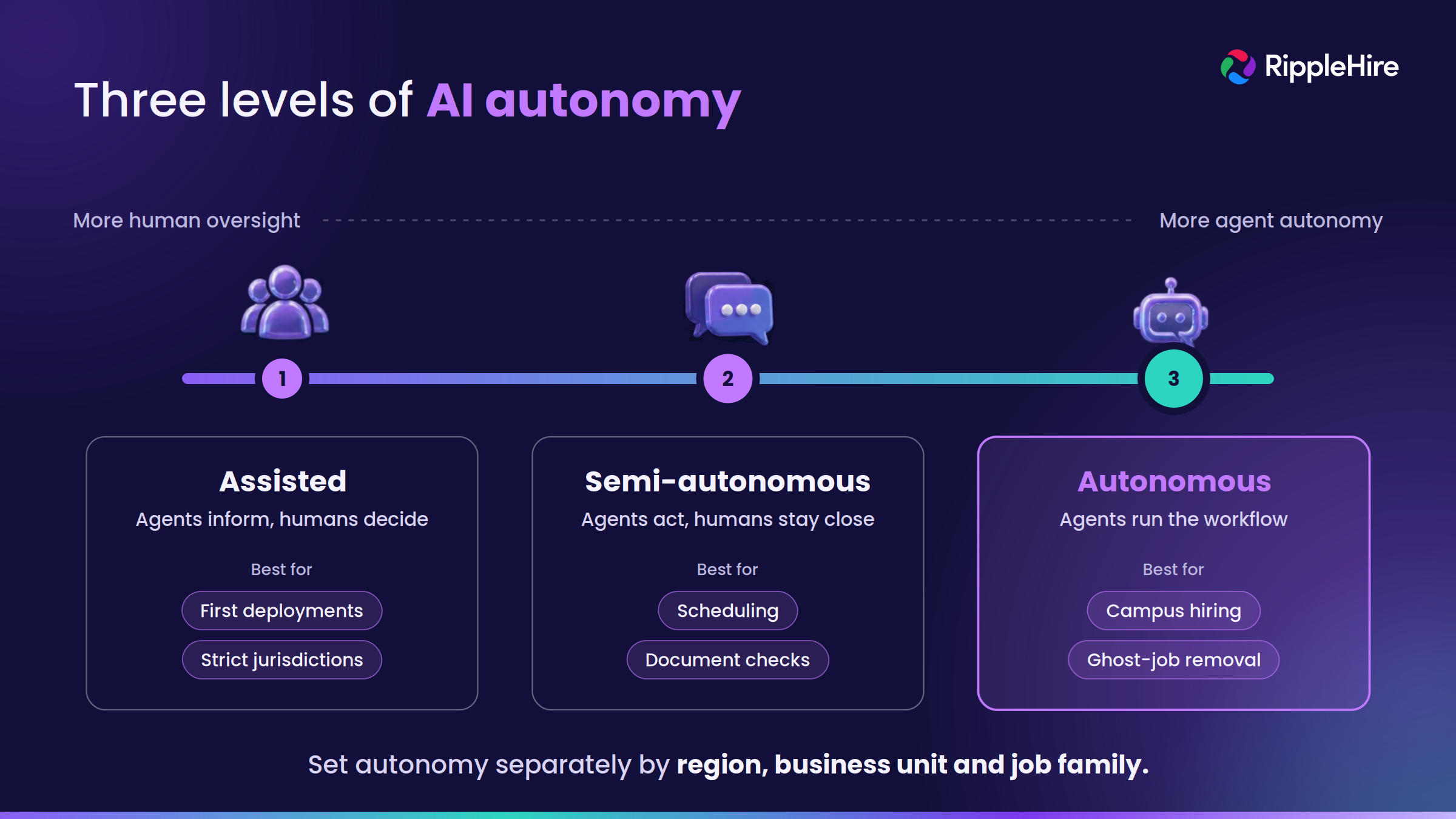
The right path is to start in Assisted mode, earn trust through the execution logs and expand autonomy step by step. Trust in agentic AI in recruitment is not declared; it is engineered through transparency, guardrails and gradual expansion.
What changes for recruiters
The recruiter role shifts from coordinator to closer. Instead of chasing interview slots, nudging panelists and checking documents, recruiters spend their time on:
- Setting direction: working with hiring managers on what the role really needs.
- Defining what "good" looks like: shaping the criteria agents use to screen and score.
- Handling exceptions: the candidates and situations that do not fit the rules.
- Building relationships and closing: negotiating offers and keeping top candidates engaged.
- Improving the system: spotting where an agent's rule needs tuning.
This is also one of the most direct answers to recruiter burnout. Enterprise teams using RippleHire AI report 40% lower time-to-hire, three to five times more hires per recruiter and 60% fewer interview no-shows, while candidate experience stays high across implementations.
AI hiring compliance: one global agent will not survive global regulation
AI hiring compliance is fragmenting by country, so your AI autonomy has to be configurable by country too. A single global policy forces every market to move at the pace of your strictest regulator.
| Region | Direction of AI hiring regulation | What it means for your harness |
|---|---|---|
| European Union | The EU AI Act classifies AI used to screen applications and evaluate candidates as high-risk. The Digital Omnibus moved those obligations to 2 December 2027. | Keep AI-assisted screening in Assisted mode, document human oversight and keep complete logs |
| United States | More than 1,000 AI-related bills were introduced across state legislatures in a single year, with several targeting automated hiring decisions. | Configure rules and notices by state; keep bias audits and decision trails ready |
| Japan | A deliberately innovation-friendly, light-touch approach to AI. | Room for more autonomy where internal policy allows |
| India | The DPDP Act shapes consent, purpose limitation and candidate data handling. | Consent capture, data retention rules and access controls built into the workflow |
Autonomy by region, business unit and job family
A harness lets you decide which specialized agents to bring in alongside TA teams, based on business unit readiness and local compliance. In practice, that might look like this:
- Campus voice screening runs in Autonomous mode in a market where it is permitted and proven.
- AI-assisted shortlisting stays in Assisted mode across the EU, with a human approving every move.
- A new agent is piloted in one BU, one geography and one job family, measured, then scaled.
Your privacy and legal teams get the freedom to enable the right level of autonomy per region, with deterministic rules and a timestamped audit trail they can defend in front of a regulator. Two related risks are worth tackling at the same time: shadow AI in recruiting and AI bias in hiring.
The economics: model-agnostic AI and AI recruiting ROI
A harness lowers the cost of AI in hiring and protects you from model price shocks. That matters more than most AI roadmaps admit.
Consider Google's Flash tier, usually the budget option. Gemini 2.5 Flash was priced at $0.30 per million input tokens and $2.50 per million output tokens. Gemini 3.5 Flash is priced at $1.50 and $9.00. That is a 5x rise on input and 3.6x on output in roughly a year. If every hiring step is a raw prompt to a single model, you absorb every one of these changes.
Three ways a harness controls cost
- It uses the model only where judgment is needed. Routing, approvals, stage movement and rule checks run deterministically inside the harness. No tokens are spent on decisions your policy already makes.
- It is model agnostic. When a better or cheaper model ships, the harness swaps it in. Workflows, rules and audit trails stay the same.
- It absorbs maintenance. When models drift or job boards change their integrations, the platform handles it. Your team manages the workflow logic, not the plumbing.
Building the AI recruiting ROI case
A CFO-ready business case for a recruiting harness usually rests on four numbers:
- Time-to-hire: days saved per hire multiplied by the cost of an open role.
- Recruiter capacity: hires per recruiter before and after, which shows headcount you avoid adding as requisitions grow.
- No-shows and drop-offs: interviews and offers saved through automated engagement. See why interview no-shows happen.
- Sourcing spend: reduced agency and job board costs as the harness draws on internal pools, referrals and data partnerships.
Track these from week one of your rollout. They become the baseline for every expansion decision that follows.
How to evaluate and roll out an AI harness for recruiting
Start small, start with volume and let the logs earn the trust. You do not need a 12-month transformation program. You need one well-chosen workflow and a clear division of responsibility.
Evaluation checklist for an agentic ATS
Use these questions in vendor demos. A true harness answers yes to all of them.
- Can business users build and change agents without code or IT tickets?
- Can every agent be dry-run against live data before activation?
- Is execution deterministic, with the same input always producing the same output?
- Is every trigger, condition and action logged against the job and the candidate?
- Can autonomy be set separately by region, business unit and job family?
- Are salary bands, approvals and consent rules enforced before an action, not after?
- Is the platform model-agnostic, with no lock-in to one LLM provider?
- Can third-party agents and partners plug into the same orchestration layer?
- Does it capture decisions and overrides as reusable context?
For a broader vendor comparison, see 10 Key Factors in Choosing an Enterprise ATS.
Who owns what
Business leaders define the job to be done. TA owns the outcomes, the rules and the definition of a good hire. IT and security own permissions, integrations and data residency. A harness needs both sides at the table from day one.
A 30-day rollout plan
- Week 1: Pick and configure. Choose your highest-cost manual workflow, ideally high-volume and repeatable with fast feedback: pipeline hygiene, approval routing or offer compliance. Configure one or two agents and dry-run them on live data.
- Week 2: Activate in Assisted mode. Switch on the first agent. Review 48 hours of execution logs with your TA team and fix any rule gaps.
- Weeks 3 to 4: Expand and measure. Add three to five agents. Move proven steps to Semi-autonomous. Set baseline metrics for time-to-hire, hires per recruiter and no-show rate for your next QBR.
- After 30 days: Scale by segment. Extend to the next BU, geography or job family, adjusting autonomy to local rules.
Build the harness, not just the agents
The enterprises that win with AI in hiring will not be the ones that deploy the most agents. They will be the ones that build a harness that learns. Models will keep improving and keep changing. Your process, your rules, your recruiters' judgment and your hiring history are what make AI work for you, and no competitor can copy them by switching models.
Over the last 24 months, RippleHire rebuilt its platform from an ATS into exactly this kind of harness: an orchestration layer that understands recruiting from demand to joiner, enforces your compliance and organizational rules, and lets agents and recruiters work side by side. Our long-term focus is on data partnerships that lower sourcing spend, turning recruiting services and TA sub-functions into configurable agents, and giving every enterprise institutional memory for recruiting.
Explore RippleHire Agent Builder →
Want to see it on your own hiring data? Book a 30-minute build session and leave with a working agent configured on one of your workflows.
Related reading:
- ATS is dead. Harness is what you need for the next decade.
- Agents coordinate, recruiters close
- Touchless Hiring in BFSI: The Operating Model for 2026
- What global enterprises get wrong about running one ATS across multiple countries
Frequently asked questions
What is an AI harness in recruiting?
An AI harness in recruiting is the orchestration layer that wraps AI models with your hiring process, policies, data and memory. It turns general-purpose models into AI recruiting agents that act within your rules and keep a full audit trail.
How is an AI harness different from an ATS?
An ATS records what happened in hiring. An AI harness orchestrates what happens next. It runs agents across the demand-to-joiner lifecycle, enforces policy at the point of action and captures context for future decisions. Many enterprises call this an agentic ATS.
What are AI agents for recruitment?
AI agents for recruitment are software agents that carry out hiring tasks on their own within defined rules, such as screening applicants, scheduling interviews, validating documents, routing approvals or following up with candidates after an offer.
Will AI agents replace recruiters?
No. Agents take on coordination and high-volume tasks. Recruiters focus on judgment, hiring manager partnership, candidate relationships and closing. In a well-designed harness, humans decide how much autonomy each workflow gets.
What does human in the loop recruiting mean?
It means a person reviews or approves AI-driven decisions at defined points. In a harness, this is configured per workflow through Assisted, Semi-autonomous and Autonomous modes, so oversight is strongest where risk is highest.
How does an AI harness help with the EU AI Act?
The EU AI Act treats AI used for screening and evaluating candidates as high-risk, with obligations applying from 2 December 2027. A harness supports compliance through human oversight settings, deterministic rules, region-specific autonomy and complete execution logs.
Do I need to choose one AI model for my hiring stack?
No. A model-agnostic harness lets you use different models for different tasks and switch as prices or capabilities change, without rebuilding workflows.
How long does it take to deploy recruiting agents?
With a no-code agent builder, a single agent can be configured and tested in under 30 minutes. A practical first rollout of three to five agents takes about four weeks.